
Top Signs You Need Garage Door Service – Don’t Ignore These
Most garage door failures don’t come out of nowhere. They send signals for weeks or months before something actually breaks: a slight grind, a door that lags on one side, a remote that needs a second push. The trouble is that those signals are easy to dismiss until the door finally quits and the car is stuck inside. A door that takes three seconds longer to open than it did six months ago isn’t just slow. It’s telling you which component is failing, if you know how to read it. Below, we walk through the warning signs and, more importantly, what’s happening mechanically behind each one.
Slow, Straining Operation: Motor Strain or Friction?
A door that opens but labors while doing it is dealing with one of two problems. The first is motor strain: the opener is working harder than it should because something in the door’s travel has added resistance. That could be a stiff roller, a dry hinge, or a track that’s been nudged out of alignment. The motor hums louder and the door seems to drag. The second is friction, which usually comes from rollers that have worn flat or a torsion spring that’s lost tension and is making the opener do work the spring is supposed to do. In our experience, slow operation is the most ignored symptom we see in Newport News, and it’s the easiest to catch early.
Here’s how to tell them apart. Stand in the garage and listen. A loud, grinding motor is strain. A door that shudders as it moves is friction. If it’s the motor, the fix is often a simple adjustment or a closer look at the opener’s drive system. If it’s friction, the door needs attention, not a new opener. Replacing the opener when the door itself is the problem just burns through the new one faster.
When to call a pro: if you notice the door slowing down and the motor getting louder, don’t wait for it to stop completely. That’s a garage door opener repair issue that’s cheaper to catch now. Call (833) 508-9227. We answer 24/7. Fast dispatch from 7am to 7pm, Sunday through Friday.
Grinding, Scraping, or Popping Noises
Noise is the door’s way of talking. A grinding sound is usually the rollers: steel rollers that have lost their bearings or nylon rollers that have worn thin will grind against the track as the door moves. A scraping sound often points to the door rubbing the frame or a panel out of alignment. A popping or snapping noise is different, and you should treat it with more caution. That’s frequently a torsion spring that’s about to give out, and a spring under tension is the most dangerous component on the whole door. High-tension springs and cables do not belong in a weekend DIY project. This is exactly the work general handymen decline and why spring repair is a specialist service.
- Grinding: worn rollers or dry hinges. Usually fixable and not urgent.
- Scraping: door out of alignment or a bent track. Have it checked soon.
- Popping or booming: spring or cable stress. Stop using the door and get a professional.
If you hear the popping, don’t run the door just to “see if it happens again.” That’s the one symptom where one more cycle can turn a repair into a bigger, costlier job. We handle spring repair safely with the right tools and training, and we’d rather you call than test it.
The Balance Test: A 30-Second Diagnostic Everyone Should Do
This is the most useful test any homeowner can run, and almost nobody does it. Close the door, then pull the emergency release cord to disconnect the opener. Lift the door by hand to about halfway and let go. A healthy door should stay roughly in place, balanced. If it slams down, the springs have lost tension. If it flies up, there’s too much tension. Either way, your springs aren’t doing their job, and the opener has been compensating, which is why it’s been working harder. Run this test in Newport News a couple of times a year, and you’ll catch spring problems before they strand you.
One safety note: the balance test is safe because you’re only lifting the door by hand. What you should never do is try to adjust, wind, or replace the springs yourself. Those springs hold enough stored energy to cause serious injury if handled wrong. The balance test tells you there’s a problem. Fixing it is a job for a trained technician. If you’re not comfortable even running the test, that’s fine too. A quick call can get a professional out to look.
Sagging Sections and a Crooked Door
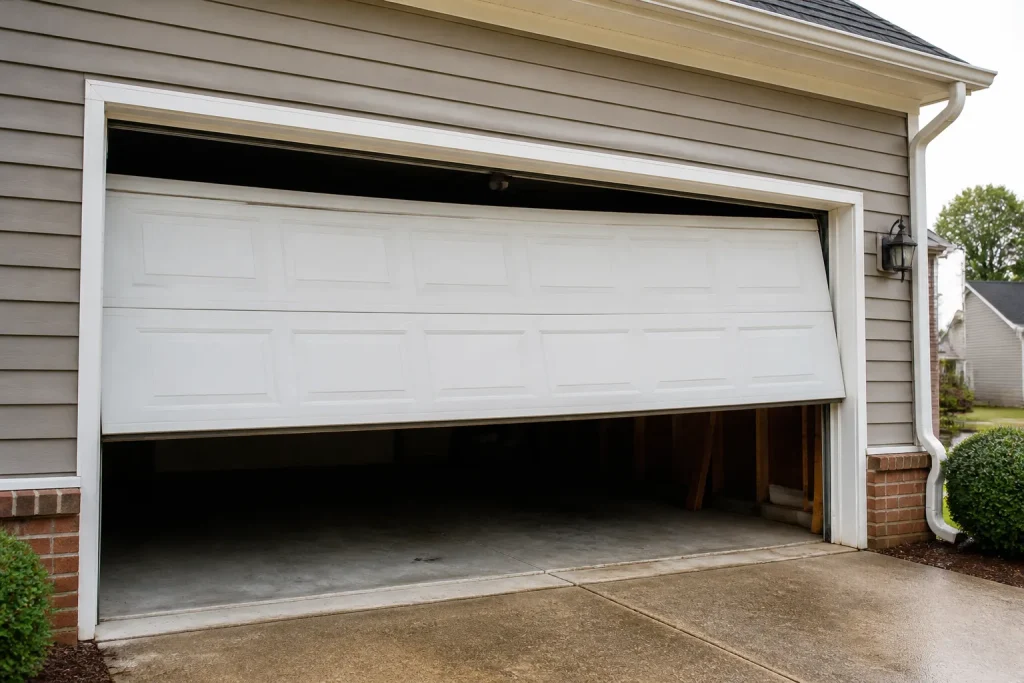
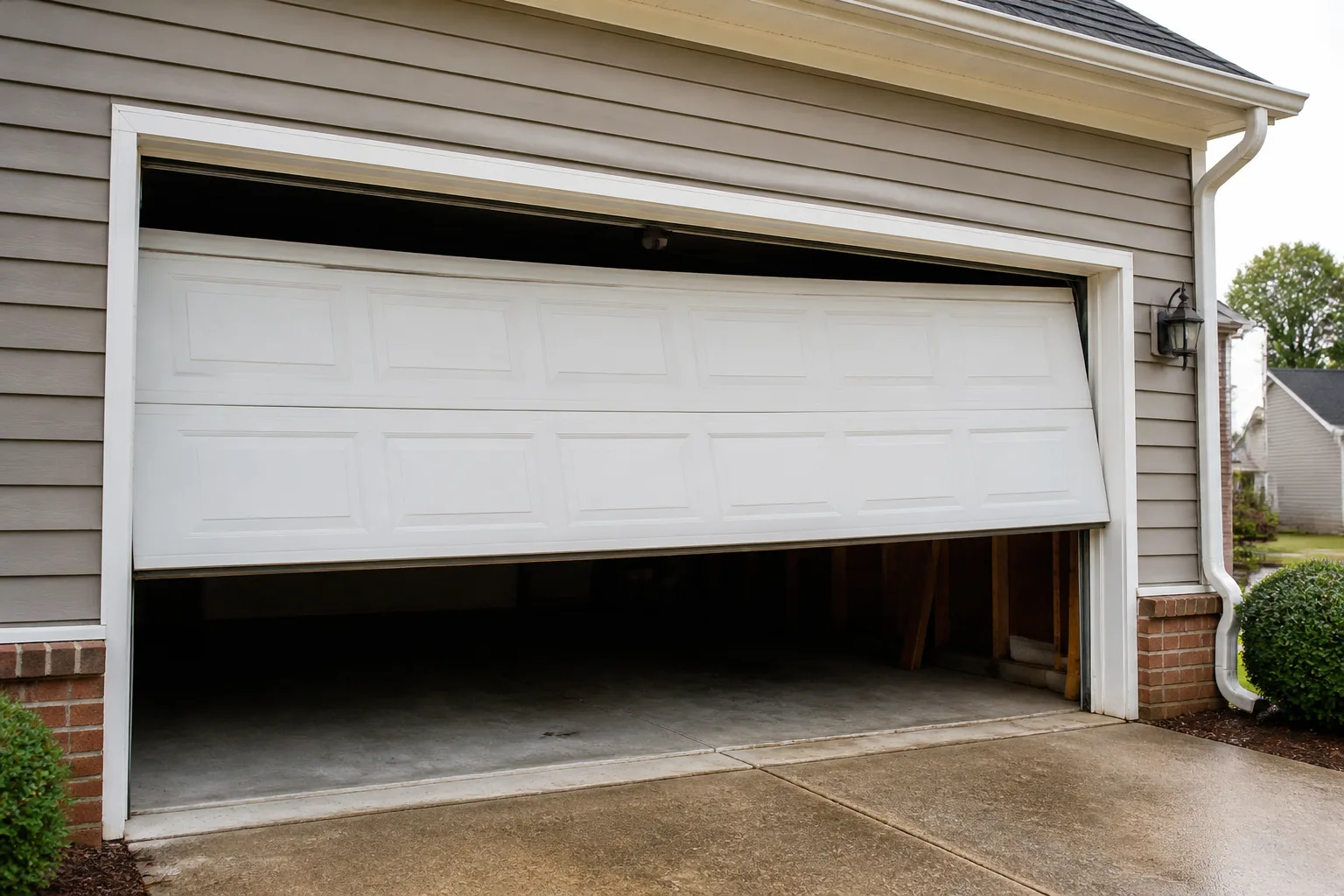
A door that looks crooked or has sections that sag is usually dealing with one of two things: hinge fatigue or spring imbalance. Hinges at the joints carry a lot of the door’s weight, and over time they wear and loosen, letting panels droop. Spring imbalance, on the other hand, means one side of the door is supported differently than the other, so the whole door tilts as it moves. Hinge wear is a maintenance issue. Spring imbalance is a sign the spring system is off and needs professional attention. Both are worth fixing before they stress the opener or the track.
Look at the gap between the door and the floor. If it’s uneven across the bottom, or one side of the door sits higher than the other when closed, that’s a sagging or imbalance signal. Left alone, a crooked door grinds against the track and can damage panels. That’s the point where a small alignment issue becomes a panel replacement. It’s a good moment to look at the whole door’s condition, and if the panels are past saving, we’ll walk you through garage door installation options from brands like Clopay, Amarr, or Wayne Dalton, based on your door and situation, not on what we’d prefer to sell.
Remote Lag and Opener Glitches
Sometimes the door is fine and the opener is the problem. A remote that takes several presses to respond, or works only when you’re close, is a common complaint. The cause is usually one of two things: the antenna or the opener’s logic board. A weak or obstructed antenna gives you short range. A logic board on its way out causes inconsistent behavior, where the remote works one day and not the next. Replacing the battery is a good first step; if the problem continues, the opener itself needs a look. We service and repair openers from Genie, LiftMaster, Chamberlain, and more. If the opener is old enough to keep failing, we can talk through repair versus replacement honestly.
Grinding, popping, or a door that lags on one side are the structural signs. Slow operation, sagging, and remote lag are the diagnostic ones. Cosmetic wear, like a faded finish or a small scuff, is usually just that: cosmetic. When it’s a safety question, watch for a door that won’t close fully, reverses on its own, or has a bottom seal that’s pulled loose. Those are “stop using the door today” signs, not “watch it” signs.
Cost of Delay: What Ignoring a Warning Actually Costs
The gap between fixing a warning sign and waiting for a full failure is real money. Here’s how the three most-ignored symptoms tend to play out. Ignoring slow operation and a straining opener typically leads to a failed opener, which is a more expensive replacement than a repair caught early. Ignoring a grinding noise leads to worn rollers damaging the track, turning a small fix into track or panel work. Ignoring a weak balance test leads to a snapped spring and a door you can’t move at all, plus the risk of cable or panel damage when it goes. Catching the signal early usually means a simple repair. Waiting means a full system fix.
When to call a pro: for grinding, sagging, or slow operation, call before the door stops working. For popping or a door that won’t move, call right away. Spring repair and opener diagnostics are specialist work, and our technicians have up to 11 years of experience. We’re trained to service eight of the industry’s most widely installed brands, so whichever name is already on your door, we can work on it.
Related services in Newport News: if you’re not sure what’s failing, start with garage door repair and we’ll diagnose it. For anything going wrong with the motor or controls, our opener service is here. And for a full replacement, Newport News Garage Door Repair Pros covers new installs across the area.
The Bottom Line
Your garage door is your home’s largest moving part, and it rarely fails without warning. Slow operation, grinding, sagging, and remote lag are all signals of a specific mechanical cause. Run the balance test a couple of times a year, listen for popping, and don’t ignore a door that suddenly behaves differently. Catching a warning early means a smaller repair. Waiting for a full failure costs more and leaves you stuck. If you’d rather have a pro read the signs, we offer free estimates across Newport News. Call (833) 508-9227. We answer 24/7. Fast dispatch from 7am to 7pm, Sunday through Friday. We work on the brand already on your door, not the one we prefer to sell, and the price is quoted and agreed before any work starts.
Frequently Asked Questions
The earliest signs are slow operation, a louder or grinding motor, and a door that lags on one side. A remote that takes more presses than it used to is also a common early warning. If you notice any of these, run the balance test to check the springs before the problem gets worse.
No. Torsion and extension springs are under high tension and can cause serious injury if adjusted or replaced incorrectly. This is one of the most dangerous repairs on the door, which is why most general handymen decline it. Leave spring work to a trained professional. Call (833) 508-9227 and we’ll take a look.
Run it about twice a year, or whenever the door starts acting differently. Close the door, pull the release cord, lift it halfway by hand, and let go. If it stays put, the springs are balanced. If it slams down or flies up, the springs need attention. It takes about thirty seconds.
Yes. A door that won’t move at all, or pops and won’t travel, is a “stop using it” problem. Don’t force it or cycle it repeatedly. Call (833) 508-9227. We answer 24/7 and offer free estimates, with fast dispatch from 7am to 7pm, Sunday through Friday.
Written by the team at Newport News Garage Door Repair Pros.
Need Garage Door Help?
Call Newport News Garage Door Repair Pros - the local pro we connect you with is licensed and insured, here with fast help in Newport News.
(833) 508-9227